

“Guardian Eye”: Driver Drowsiness Detection and Auto Braking
Team Members: Tank Krish D., Khambhayata Krish H.
Guided by: Dr. Komil Vora
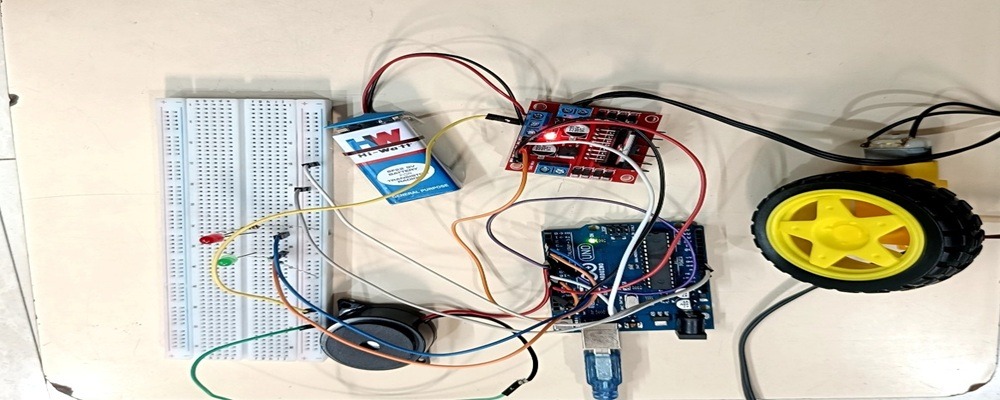
Guardian Eye is an intelligent driver safety system developed to detect drowsiness and prevent road accidents caused by fatigue. The system uses a camera along with sensors to continuously monitor the driver’s eye movements, blinking rate, and head position in real time. By analyzing these parameters, it can accurately identify signs of sleepiness or loss of attention. When drowsiness is detected, the system immediately activates an audible alarm to alert the driver and encourage them to regain focus. If the driver does not respond within a specified time, the system automatically applies the vehicle’s braking mechanism to reduce speed safely and minimize the risk of a collision. This project aims to improve road safety, reduce fatigue-related accidents, and provide a reliable driver assistance solution for safer transportation.
CleanTrack: An AI and IoT-Based Smart Waste Management System
Team Members: Dev Khandhediya, Bhargav Vaghela
Guided by: Dr. Darshana Patel
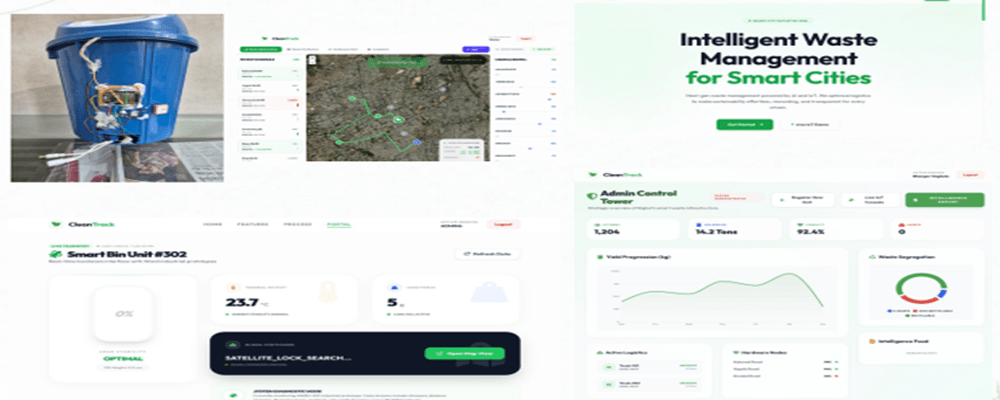
CleanTrack is an Artificial Intelligence (AI) and Internet of Things (IoT) based Smart Waste Management System designed to improve the efficiency of municipal waste collection through real-time monitoring, intelligent waste classification, and optimized collection planning. The system utilizes smart sensors to monitor waste bin status and transmits the collected data to a cloud platform for centralized monitoring and automated alerts. An AI-based waste classification model identifies waste categories such as plastic, paper, cardboard, metal, glass, and organic waste, promoting effective segregation and improved recycling. A Genetic Algorithm-based route optimization module prioritizes waste collection and determines the shortest collection path, reducing fuel consumption, operational costs, collection time, and carbon emissions. With its modular, scalable, and cost-effective architecture, CleanTrack supports sustainable waste management, enhances public hygiene, and provides an innovative solution for smart cities and environmentally responsible urban development.
TerraSense: IoT-Enabled Soil Analysis Framework for Real-Time Crop Recommendation
Team Members: Reeva Maulik Kanakhara
Guided by: Dr. Darshana Patel
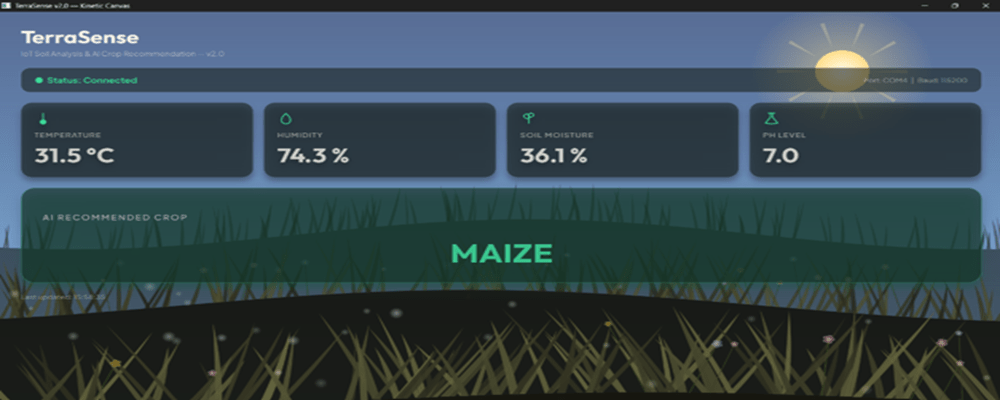
Indian agriculture still leans heavily on generalised, lab-delayed soil testing, which wastes resources and caps yields. TerraSense tackles this with a low-cost, edge-deployed IoT and machine-learning framework that gives farmers real-time, hyper-localised crop guidance. An ESP32 microcontroller paired with a DHT11 sensor, a capacitive soil-moisture probe and an analog pH sensor streams a four-parameter telemetry feed over a 115200-baud serial link. Since deploying industrial NPK probes is costly, a software-defined imputation layer fills in the remaining fields using standard regional soil benchmarks, producing the eight-feature vector the model needs. This vector is classified by a trained Random Forest ensemble, which reached 100% test accuracy, a result corroborated by stratified 5-fold cross-validation (100%, zero variance) and a Logistic Regression control model (99.2%), confirming the classes are genuinely separable rather than overfit. On the software side, a QThread-based asynchronous design keeps serial I/O off the GUI thread, so the custom PySide6 Kinetic Canvas visualisation stays fluid during continuous updates. End-to-end latency lands around 120 ms, versus 850 ms-plus for comparable cloud-based systems. Together, accessible hardware, disciplined validation, and an internet-independent pipeline make TerraSense a practical, scalable blueprint for precision agriculture.
Bathymetry Mapping With Unmanned Underwater Bots
Team Members: Devanshu Joshi
Guided by: Dr. Darshana patel, Prof. Dishita Mashru
Bathymetry is the measure of the depth of water in seas, oceans, rivers, or lakes. Oceans cover 71% of the surface of the earth and the bathymetry is mapped precisely up to a resolution of 1.5×1.5 km^2, whereas land topography is mapped up to 30×30 cm^2 resolution. This means that we cannot utilize our resources completely. Oceans are used all the time for laying network cables, shipping resources, food, and even crude oil mining from oil rigs. This makes it necessary to develop better maps so that fewer resources could be wasted. This paper then describes the approach of bathymetry mapping using unmanned bots and their architecture; not having or needing a crew or staff. A new industry is born, as soon as these maps are generated, saving resources, studying marine biology, and even developing new engineering techniques. Mapping could be done in several ways proposed in this paper. This paper focuses on generating bathymetric maps using multibeam sonar with the help of unmanned underwater bots with implemented work on small-scale underwater unmanned bots with some basic sensors, gathering insights like temperature profile, water quality level, and surface pattern on a real-time data set
Enhancing Face Detection and Recognition in Video using Deep Learning
Team Members : Nimesh Kadecha, Nakul Maniar, Vrajesh Patadiya, Shreya Ghetiya
Guided by : Dr. Darshana Patel, Prof. Aditiba Jadeja
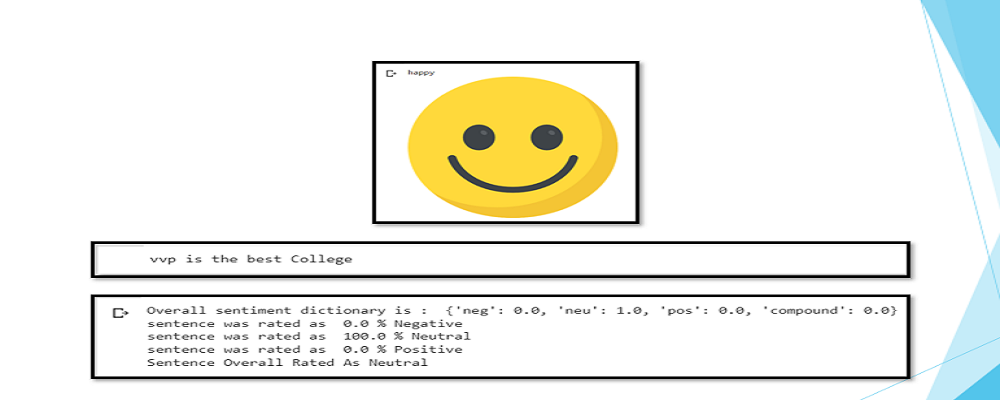
In today’s world, deep learning is gaining significance due to its advancements in enabling automation and driving innovations across various fields. Face detection and recognition are crucial for security, surveillance, and user authentication, as they enable automated identification, access control, and enhanced safety in systems such as CCTV monitoring, biometric verification, and personalized services. Searching for specific individuals in security camera footage is a time-consuming process that demands constant human attention; besides, humans may make mistakes. This research aims to develop a system that can automatically search through video data by detecting the faces of people, making the process faster and easier compared to humans who do it manually. This involves the conversion of videos into frames using OpenCV for video processing. Then, DeepFace further accomplishes accurate face recognition by comparing each frame with the reference image that has been provided. The enhancement of this system has been achieved through parallel processing, which optimizes the handling of large video files by utilizing multiple CPU cores. This approach speeds up the face detection and recognition tasks by distributing the workload across several processing units, thereby improving efficiency and reducing the overall processing time.
Solar Panel Faults Detection System
Team Members: Harsh Devmurari, Shivam Ameta, Devalba Jadeja
Guided by: Dr. Darshana Patel, Prof. Aditiba Jadeja
In the face of growing global energy demands, solar photovoltaic (PV) modules have emerged as a vital renewable resource. However, environmental factors such as dust accumulation, bird droppings, and mechanical defects can significantly reduce power output. Traditional inspection methods, reliant on manual visual checks, are time-consuming and prone to human error. The adoption of deep learning, especially convolutional neural networks (CNNs), offers a powerful solution by automatically identifying anomalies in both infrared and electroluminescence images. Through feature extraction and classification algorithms like CNN, microcracks, hotspots, and other malfunctions can be accurately detected. This early detection paves the way for timely maintenance, minimizing downtime and prolonging module lifespan. Furthermore, advanced techniques such as data augmentation and explainable AI tools enhance model performance, transparency, and user confidence. By integrating meteorological data with historical power output, machine learning models can also predict the expected energy generation, triggering alerts when actual performance falls below the forecasted threshold. The result is a comprehensive fault detection system that not only optimizes power generation but also reduces operational costs. As solar adoption continues to rise, robust, AI- driven defect detection ensures greater reliability, improved efficiency, and sustainability forthe solar energy sector and fosters ongoing innovation. The paper uses different measures to evaluate the performance of the system such as confusion matrix, accuracy, loss and epochs considering different datasets.
Detection of Flaws in Machine Parts Using Ultrasonic Sensors
Team Members: Devanshu Joshi
Guided by: Dr. Darshana patel, Prof. Dishita Mashru
Several billions of machine parts are being manufactured per day in different parts of the world. Recalling the fact that only some things are perfect and considering just 2% of the average error rate we get millions of defective products. Some are crucial objects, which if used defective can cause mass destruction or fatality to human life. Some parts get errors in them while they are being transported from one place to another, hence a sophisticated mechanism is required for their testing. Some methods include the utilization of Artificial Intelligence with the help of camera vision which in turn results in an expensive approach to resolve the issue. This project provides a new, and economical prospect with the usage of Ultrasonic Sensors and provides a brief on how precise error detection could be achieved using these sensors. A 3D Point Cloud is generated from the distance data points captured and then compared with the ideal object.
AUTO BILLING AND INVOICING SHOPPING CART
Team Members : Hetvi Karavadiya
Guided by : Dr. Darshana Patel, Prof. Dishita Mashru
This is an Auto Billing Invoicing Shopping Cart. There is a general problem, standing in a queue whenever you visit any shopping mall or shopping mart. The people especially the old aged mass cannot stand for a longer time in a queue. So, to overcome this problem we have invented the auto billing cart. This Cart can be used at many places such as shopping mall, Airports, Shopping marts etc. This Cart has wonderful features. One of the most important features of this cart is that it has an automated system of billing. So, when you keep the items, you want to purchase, into the cart, it will show the total price of the items. It is having a LED Display that will display the price. And, it has a wonderful another feature that if you do not want to pay the amount in cash you can also pay through your card. There will be a QR Code Scanner on the cart so by which you can pay online. By this all features it is so helpful to everyone regardless of their age. The display of the cart will be charged by the battery cells. So, one of the small disadvantages of this trolley is one must keep an eye on the battery cells. If the battery will not be working properly than it will not function properly. So, one must change the battery cells regularly. So, when used properly it is the best invention so far.
Smart Medicine Box
Team Members: Samarth Vekariya
Guided by: Dr. Darshana Patel, Prof. Dishita Mashru
A smart medicine box is a device that helps individuals keep track of their medication schedules and ensures that they take their medication as prescribed. The box uses technology to provide reminders and alerts to patients or caregivers, so they don’t miss a dose or take the wrong medication. The smart medicine box typically features compartments or slots for each medication, which are programmed with a specific
medication schedule. The device uses buzzer or alerts to remind patient when to take medicine. User can schedule particular time for particular medicines, as the time for medicine was scheduled
buzzer will rang or alerts will be sent. Smart medicine boxes can be connected to a smartphone app or web portal, allowing patients and caregivers to monitor medication adherence and receive alerts or notifications even when they are not at home. The app can also provide detailed reports on medication usage and adherence over time, allowing healthcare providers to track the patient’s progress and adjust the treatment plan as needed. Overall, smart medicine boxes can be a useful tool for individuals who take multiple medications or have difficulty remembering to take their medication as prescribed. They can help reduce medication errors and improve medication adherence, which can lead to better health outcomes and reduce the risk of complications. Smart pill boxes have the potential to become an important tool in the management of chronic conditions and the promotion of patient self-care. They can help reduce medication errors and improve medication adherence, which can lead to better health outcomes and reduce the risk of complications.